Kaspersky: Our system is highly tailored, developed for solving a specific narrow task, and not intended for playing Half-Life on, editing your vacation videos, or blathering on social media.Second: we’re working on methods of writing software which by design won’t be able to carry out any behind-the-scenes, undeclared activity. This is the important bit: the impossibility of executing third-party code, or of breaking into the system or running unauthorized applications on our OS; and this is both provable and testable.
Russia: Kaspersky AV company is Developing Its Own Operating System
October 21, 2012
 Leave a Comment » |
  חדשות |
  Permalink
 Posted by Editor
A Study of Zero-Day Attacks In The Real World
October 19, 2012Zero-day vulnerabilities and exploits dominate headlines and most heated information security discussions. In truth, however, there are relatively few of these attacks hitting a small number of hosts, according to new research on the subject.
The reason zero days eat up so much bandwidth is because of their effectiveness in compromising targets and avoiding detection. Researchers Leyla Bilge and Tudor Dumitras of Symantec Research Labs looked at period of malware activity on a host of Symantec detection platforms from 2008 to 2011 and quantified the window of exposure organizations face from attacks that are active before vulnerabilities are publicly disclosed.
Link To The Study : http://users.ece.cmu.edu/~tdumitra/public_documents/bilge12_zero_day.pdf
Leave a Comment » | חדשות | Permalink
Posted by Editor
Microsoft report on computer security in Israel 1-6/2012
October 19, 2012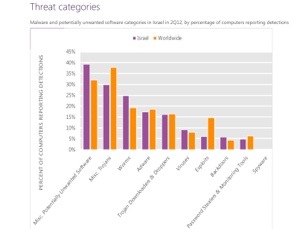
Leave a Comment » | חדשות | Permalink
Posted by Editor
Hackers Launch New Wave Of U.S. Bank Attacks
October 12, 2012The hackers behind recent disruptions of U.S. bank websites this week launched a new wave of attacks.
The attacks were previewed Monday in a Pastebin post from Izz ad-Din al-Qassam Cyber Fighters, which promised to attack Capital One (Tues.), SunTrust Banks (Wed.), and Regions Financial (Thurs.), beginning at 2 p.m. British Time each day, and lasting for eight hours.
http://www.informationweek.com/security/attacks/hackers-launch-new-wave-of-us-bank-attac/240008917
Leave a Comment » | חדשות | Permalink
Posted by Editor
US can trace cyberattacks, mount pre-emptive strikes, Panetta says
October 12, 2012WASHINGTON — The U.S. military now has the ability to trace a cyberattack back to its source and mount pre-emptive operations when an impending assault is detected, Defense Secretary Leon Panetta declared Thursday.
Leave a Comment » | חדשות | Permalink
Posted by Editor
Expert fingers DDoS toolkit used in US bank cyberattacks
October 2, 2012Cyberattackers who disrupted the websites of U.S. banks over the last two weeks used a highly sophisticated toolkit — a finding that points to a well-funded operation, one security vendor said on Monday. Prolexic Technologies said the distributed denial of service (DDoS) toolkit called itsoknoproblembro was used against some of the banks which included Wells Fargo, U.S. Bank, PNC Bank, Bank of America and JPMorgan Chase. Each of the banks was struck on separate days.
http://www.networkworld.com/news/2012/100112-expert-fingers-ddos-toolkit-used-262946.html
In the most recent attacks, the traffic coming in was the equivalent to about 65 gigabytes per second, Smith says. “A typical DDoS attack waged by a hacktivist group looks much different than what we saw here,” he says. “You would expect less than 1 gbps [gigabyte per second] of attack traffic for the average hacktivist, and would expect peaks up to, maybe, 2 gbps.”
http://www.bankinfosecurity.com/new-bank-attacks-expected-today-a-5155/op-1
Leave a Comment » | חדשות | Permalink
Posted by Editor
Chinese “hackers” break in to White House military office network
October 1, 2012Hackers linked to China’s government broke into one of the U.S. government’s most sensitive computer networks, breaching a system used by the White House Military Office for nuclear commands, according to defense and intelligence officials familiar with the incident.
http://freebeacon.com/white-house-hack-attack/
and the result :
President Barack Obama on Friday took the rare step of blocking foreign investment in a U.S. company, invoking national-security concerns to prevent a firm owned by two Chinese nationals from acquiring four wind-farm projects in Oregon.
http://newsfeedresearcher.com/data/articles_b40_2/president-obama-national.html#hdng0
Leave a Comment » | חדשות | Permalink
Posted by Editor
Russia Unveils Secure “Almost Android” Tablet To Keep Data Away From Google
September 1, 2012Russia’s top officials have been unnerved by the idea that data collected and stored for years in Google databases could slip into the hands of the US government and expose some of their most secret and sensitive communications.
Similar fears have already driven other expensive military projects with rewards for the masses that come primarily as an afterthought.
One such invention is GLONASS — a rival of the Global Position System (GPS) meant to help generals train their missiles on targets without relying on a US system that could be shut down as a precaution at any point.
http://www.securityweek.com/russia-unveils-secure-android-tablet-keeps-data-away-google
Leave a Comment » | חדשות | Permalink
Posted by Editor
Cyber attack takes Qatar’s RasGas offline
August 30, 2012RasGas, the second largest producer of Qatari LNG after Qatar Petroleum, has been hit with an “unknown virus” which has taken the company offline. A RasGas spokesperson confirmed that “an unknown virus has affected its office systems” since Monday 27 August.
http://www.arabianbusiness.com/cyber-attack-takes-qatar-s-rasgas-offline-471345.html
Leave a Comment » | חדשות | Permalink
Posted by Editor
Exposing China’s vast underground economy, 90,000 people work on the dark side of the Net
August 26, 2012A new academic study has set out to illuminate for the first time the size and structure of the Chinese online underground, and found it affected nearly a quarter of the country’s internet users last year and cost the economy over 5 billion yuan (£500m).
Investigating China’s Online Underground Economy was put together by researchers at California University’s Institute on Global Conflict and Co-operation to highlight the scale and sophistication of China’s cyber black market and to aid global collaboration efforts against hi-tech crime.
The report claims that in 2011 the online underground involved over 90,000 participants, costing the local economy 5.36 billion yuan (£536bn), making victims of 110m internet users (roughly 22 per cent) and affecting 1.1m web sites (20 per cent).
To calculate these figures, the report used stats provided by the major local security vendors, court room documents detailing high profile cases and messages from the underground markets themselves which were relatively easy to track down on certain public web platforms.
Link to the research : http://igcc.ucsd.edu/assets/001/503677.pdf
http://www.theregister.co.uk/2012/08/18/baidu_tencent_used_by_chinese_cyber_crims/
Leave a Comment » | חדשות | Permalink
Posted by Editor

 ClearSky Cyberdefense Forum